
South Euclid basements face a relentless battle against groundwater due to the heavy clay soil common across the Cleveland metro area. When you walk down your stairs and feel that familiar damp chill or see standing water after a heavy rain near Euclid Creek, your first instinct is likely to head to a big box store for a portable dehumidifier. While these retail units work for minor seasonal humidity, they are physically incapable of handling a true water intrusion event. A standard dehumidifier removes moisture from the air to make a room feel more comfortable, but it cannot pull deep moisture out of structural materials like 2×4 wall studs, sill plates, or concrete masonry units. When water saturates your home, you need industrial grade equipment designed for structural drying rather than simple air conditioning.
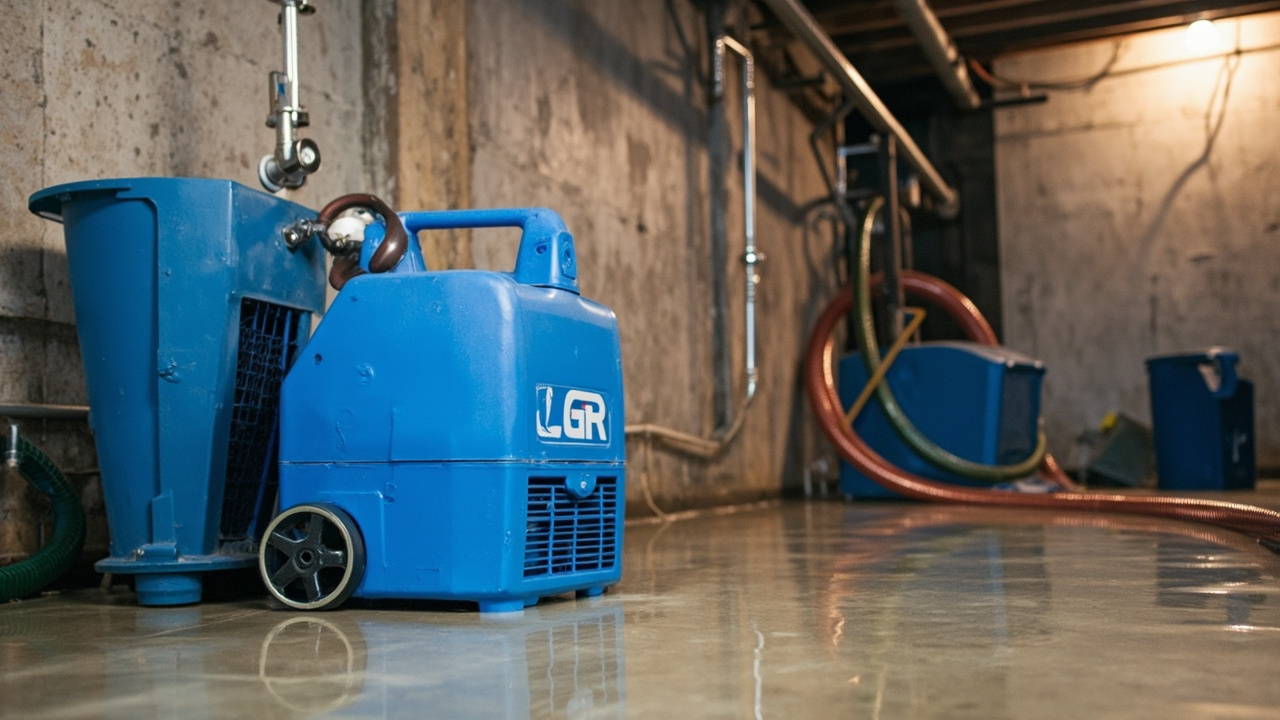
The difference between a consumer grade appliance and professional water restoration equipment involves a science called psychrometry. This is the study of air, moisture, and temperature relationships. In 2026, professional restorers use Low Grain Refrigerant (LGR) dehumidifiers that can continue to remove water from the air even when the relative humidity levels drop below 30 percent. Most retail units stop being effective once the room reaches a certain temperature or humidity level. If you are dealing with a significant event, such as a pipe repair emergency in Westlake or a flooded basement in South Euclid, the equipment you choose determines whether your home remains structurally sound or develops long term mold issues.
The technical limitations of retail dehumidifiers in South Euclid
Most retail dehumidifiers are rated by how many pints of water they can remove in a 24 hour period under ideal conditions. Usually, these conditions are 80 degrees Fahrenheit and 60 percent humidity. However, your South Euclid basement is likely much cooler than that, especially in the spring or fall. As the temperature drops, the coils in a standard dehumidifier often freeze over, rendering the machine useless. Industrial LGR units are engineered to operate in much lower temperatures and use a pre-cooling process to condense more water out of the air. This is vital for homeowners in Cuyahoga County where basement temperatures rarely stay in the ideal range for consumer appliances.
Capacity is the most obvious hurdle. A large retail unit might claim to remove 50 pints per day, but that is a measured rate for the air only. In a flooded basement, the water is not just in the air. It is inside the drywall, trapped under floorboards, and soaked into the carpet padding. Professional grade machines used by top restoration pros in Cleveland can remove 150 to 200 pints per day even in challenging environments. Without this high capacity, the evaporation rate of the water in your walls will exceed the dehumidifier’s ability to remove it, leading to secondary water damage.
Comparison of dehumidification equipment performance
| Feature | Retail Consumer Unit | Industrial LGR Dehumidifier |
|---|---|---|
| Daily Water Removal (PPD) | 20 to 50 Pints | 130 to 250+ Pints |
| Lower Operating Limit | 55 to 60 Degrees F | 33 to 40 Degrees F |
| Airflow Capacity (CFM) | 150 to 250 CFM | 350 to 600+ CFM |
| Grain Depression Ability | Low (Poor drying) | High (Deep structural drying) |
| Continuous Drainage | Manual bucket or gravity | Built in high lift condensate pump |
Understanding grain depression and vapor pressure
To dry a house properly, we look at Grains Per Pound (GPP) instead of just relative humidity. GPP is a measure of the actual weight of the water vapor in the air. If the air in your basement has a high GPP, it cannot absorb any more moisture from your wet walls. Professional LGR dehumidifiers create a massive grain depression, which means the air coming out of the machine is much drier than the air going in. This creates a vapor pressure differential. The dry air acts like a sponge, pulling moisture out of the deep pores of wood and concrete. Retail units simply do not have the cooling capacity to lower GPP enough to dry structural elements. They might make the air feel dry, but the wood framing behind your walls remains saturated.
This hidden moisture is why mold remediation in Shaker Heights and South Euclid is so common after DIY drying attempts. Homeowners think the basement is dry because the floor looks clear, but the moisture is still sitting at the base of the wall studs. According to the IICRC S500 standard for professional water damage restoration, specialized equipment is required to ensure that materials reach their dry standard. This standard is the benchmark for the restoration industry in 2026 and is used by insurance adjusters to verify that a job was done correctly.

The role of high velocity air movers in structural drying
A dehumidifier is only one part of the equation. In a professional setup, we use high velocity air movers to strip the boundary layer of saturated air from the surface of wet materials. This accelerates evaporation. If you use a retail dehumidifier without industrial air movers, the air directly against your wet drywall remains at 100 percent humidity even if the middle of the room feels drier. Professional restorers strategically place air movers to create a vortex of air that hits every corner of the room. This ensures that no pockets of stagnant, wet air remain to foster mold growth. This is especially important for flooded basements in Lakewood and South Euclid where the layout often includes small utility closets or crawl spaces.
When you combine LGR dehumidifiers with industrial air movers, you create an environment where water is forced out of the structure and captured by the machine. This process must be monitored daily with moisture meters and thermal imaging cameras. We use these tools to create a moisture map of your South Euclid home. Without moisture mapping, you are just guessing at whether your home is dry. A retail dehumidifier does not come with a technician who knows how to use a penetrating moisture probe to check the subfloor under your carpet.
Typical drying timelines for basement materials in 2026
| Material Type | Retail Unit Drying Time | Industrial LGR Drying Time |
|---|---|---|
| Standard Drywall | 7 to 10 days (Incomplete) | 2 to 3 days |
| Structural Wood Framing | 14+ days (High risk) | 3 to 4 days |
| Concrete Foundation Walls | Often never fully dries | 3 to 5 days |
| Carpet and Padding | Not recommended | 24 to 48 hours |
Why South Euclid soil makes basement drying harder
South Euclid is known for its heavy clay soil. Clay holds onto water much longer than sandy soil. This creates hydrostatic pressure against your foundation walls. When it rains heavily in Cleveland, the ground around your home becomes a heavy, wet blanket. This water can seep through hairline cracks in the concrete or enter via the cove joint where the floor meets the wall. Because the soil remains wet for days after a storm, your basement is constantly being introduced to new moisture via capillary action through the foundation. A standard dehumidifier cannot keep up with this constant influx of humidity. You need the high PPD removal rates of industrial equipment to counteract the moisture wicking through your concrete walls.
If you have experienced a sewer backup in Parma or a basement flood in South Euclid, the water is also likely contaminated. Retail dehumidifiers are not designed to be sanitized. They often have internal parts that can trap bacteria and mold spores. Professional equipment is built to be cleaned and disinfected after every use, ensuring that you are not blowing contaminants around your home during the drying process. In 2026, air quality is a major concern for Cleveland families, and using the right equipment is the only way to protect the air you breathe after a water loss.
Our professional structural drying process
When we arrive at a South Euclid home, we do not just plug in a machine and leave. We follow a strict protocol to ensure your home is restored to its pre loss condition. This process includes several critical steps.
- Initial moisture mapping using infrared thermal imaging to find water hidden behind walls and under floors.
- Extraction of standing water using high powered truck mounted vacuums that are far more effective than a wet dry vac.
- Application of EPA approved antimicrobials to prevent mold growth on organic surfaces like wood and drywall.
- Strategic placement of LGR dehumidifiers and high velocity air movers to maximize the evaporation rate.
- Daily monitoring of temperature, relative humidity, and GPP to track the drying progress and adjust equipment as needed.
- Final verification once all materials have reached their documented dry standard.
By using this scientific approach, we can often save materials that would otherwise have to be torn out. This includes hardwood floors and custom cabinetry that are susceptible to warping if not dried quickly. The Environmental Protection Agency recommends that all wet materials be dried within 24 to 48 hours to prevent mold growth. This window is very small, and retail dehumidifiers simply cannot move enough air or remove enough water to meet this deadline.

Protecting your South Euclid investment from long term damage
Your home is likely your largest investment. Trying to save money by using a retail dehumidifier after a basement flood often leads to much more expensive repairs later. Mold can begin to grow within 48 hours, and structural rot can set in over the following weeks. In South Euclid, where many homes feature beautiful historic architecture and solid wood construction, the stakes are high. Professional restoration ensures that the value of your home is protected and that your indoor air quality remains safe for your children and pets.
The 2026 weather patterns in the Cleveland area have brought more frequent and intense storms. This means South Euclid basements are under more stress than ever before. Having a plan for professional water mitigation is essential for every homeowner in the area. When you choose industrial grade dehumidification, you are choosing the most reliable way to dry your home and prevent the secondary damage that follows every water intrusion. If you find your basement damp or flooded, stop the cycle of ineffective DIY drying and bring in the equipment designed for the job.
Professional water restoration services are available throughout Cuyahoga County to help you handle everything from a burst pipe to a major flood. Our team understands the unique challenges of Cleveland weather and the specific needs of South Euclid homes. We provide the technical expertise and the industrial equipment required to get your life back to normal quickly and safely. Contact a local restoration expert today to ensure your basement is truly dry.